May contain, Contains lines and free-from claims: how AllergenLens reads them
How AllergenLens handles may contain and shared-facility warnings, the Contains line, ingredients that can come from an allergen, and free-from claims.
Short answer
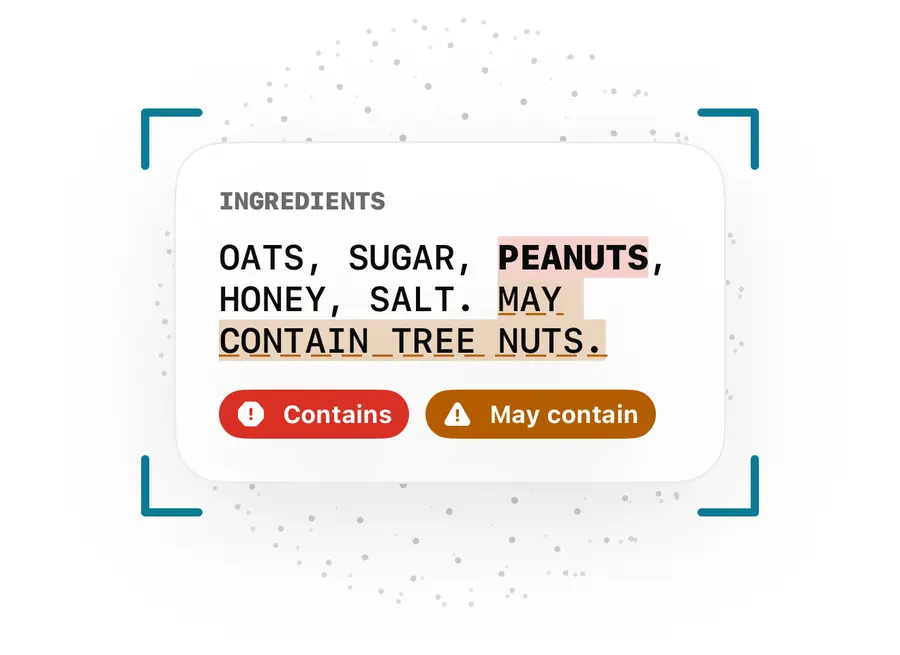
AllergenLens treats every may contain, traces of or shared-facility warning that names something on your profile as May contain, and asks you to check with the maker. It reads the Contains line as well as the full ingredient list and points out when the two disagree. Ingredients that can come from an allergen, such as lecithin, are flagged as May contain. Free-from claims are shown for information only and never clear anything.
The ingredient list is only part of what a label says about allergens. There is often a Contains line, a warning about traces or shared equipment, and sometimes a claim such as gluten-free. AllergenLens reads all of them, but it doesn't treat them the same way. This post explains how each kind of wording affects a result, and where the app hands the question back to you.
Precautionary warnings: May contain
Labels warn about cross-contact in many ways: may contain, may contain traces of, traces of, made in a facility that also processes, made on shared equipment, may have come into contact with, and more. AllergenLens knows over a hundred of these phrases across the languages it reads. When one of them names something on your profile, that item becomes May contain, and the finding says it is in a “may contain” or shared-facility statement.
The app doesn't rank these phrases. A made in a facility line is not treated as lower risk than may contain, because the wording alone doesn't tell you how likely cross-contact is. The result includes a card called Cross-contact wording on this label that quotes each statement word for word and lists the names it found in it. Under it, the app explains that in the US this wording is voluntary and doesn't show how likely cross-contact is, that AllergenLens treats them all as May contain, and that you should ask your allergist which to avoid.
The Contains line
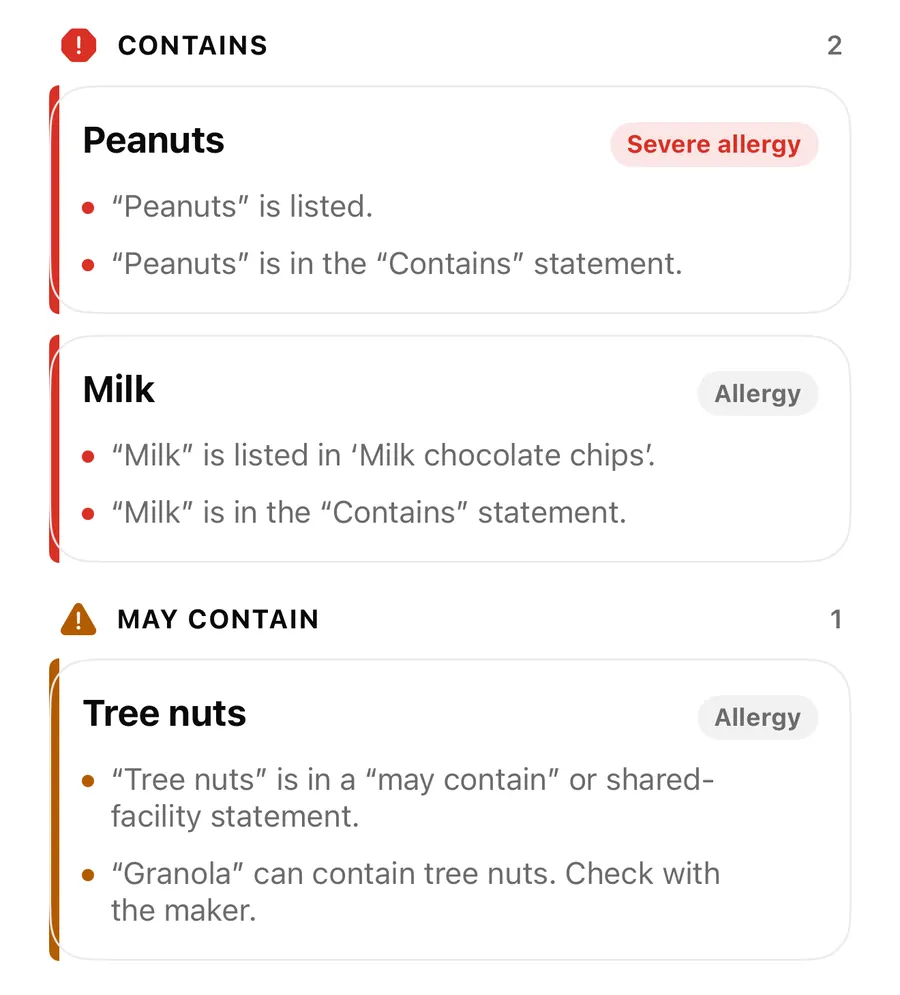
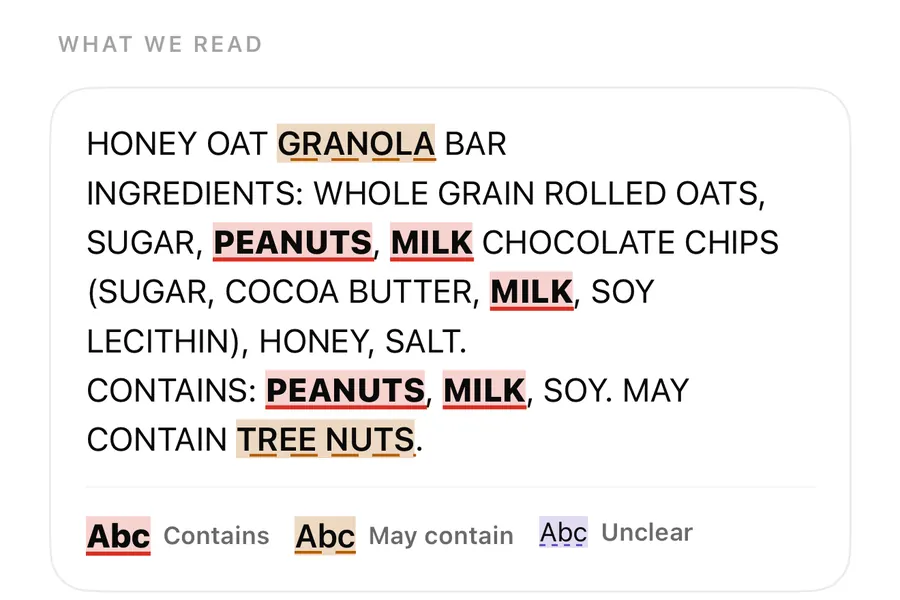
Many packs end the list with a line such as Contains: peanuts, milk, soy. If that line names something on your profile, the finding says it is in the “Contains” statement, and the result is Contains, just as if it were in the list.
AllergenLens doesn't rely on the Contains line alone. It still reads every ingredient, because the line can be shorter than the list and not every country requires one. When the whole list was read, the app also compares the two for the major allergens and adds a note if they don't agree:
- If the list has an allergen the Contains line leaves out, the note says the Contains line doesn't name it but the ingredient list does, and asks you to check with the maker.
- If the Contains line names an allergen the app couldn't match in the list, it says the allergen may be under a name its word list doesn't know, and offers Report a miss.
These notes never lower a result. A Contains match stays Contains.
Ingredients that can come from an allergen
Some ingredients don't name an allergen but are often made from one. AllergenLens knows many of these and flags them as May contain with the reason, for example “Granola” can contain tree nuts. Check with the maker. The same goes for E-numbers: E322, lecithin, can come from soy or eggs, so it is shown as May contain with Check with the maker. When an E-number always comes from one source, the note says it is made from that source instead; E1105, lysozyme, is made from eggs.
Diet rules work the same way. An ingredient that may or may not be animal-based is shown as can be animal-derived. Check with the maker. The E-numbers and unclear words post goes deeper on these names, and our guide on derived ingredient names lists common ones.
| Label wording | What AllergenLens shows |
|---|---|
| Peanuts in the ingredient list | Contains, listed |
| Contains: milk | Contains, in the Contains statement |
| May contain tree nuts | May contain, check with the maker |
| Made in a facility that also processes sesame | May contain, check with the maker |
| Granola, or E322 (lecithin) | May contain, can come from it |
| Gluten-free | A note: shown for information only |
Free-from claims
Claims such as gluten-free, free from milk, contains no nuts or made without eggs are things the maker says about the product. AllergenLens doesn't count the allergen word inside a claim as a match, so nut free on a pack doesn't flag nuts. It shows the claim as a note: The label says “gluten-free”. Shown for information only.
What it never does is use a claim to clear anything. If a free-from pack lists an ingredient on your profile, or carries a may contain warning, those findings stand. And a claim doesn't turn Not found into anything stronger. Not found in the text we read is still not a guarantee.
Read the warnings on a result
- Scan the whole label, including the Contains line and any warning under the list.
- Look at the top card. May contain means a warning or a possible source, not a listed ingredient.
- Open the findings to see the reason for each one.
- Read the Cross-contact wording on this label card for the exact statement.
- If the item matters to you, check with the maker, and follow what your allergist has told you about precautionary labels.
FAQ
Does AllergenLens treat traces of differently from may contain?
No. All precautionary wording that names something on your profile is shown as May contain, with the exact statement quoted so you can judge it.
If a pack says gluten-free, will AllergenLens show Not found for wheat?
Not because of the claim. The claim is shown for information only. The result depends on the ingredients and warnings that were read, and Not found is never a guarantee.
Why does it flag granola when the label doesn't say nuts?
Granola can contain tree nuts, so it is shown as May contain with a reminder to check with the maker.
What if the Contains line and the list disagree?
AllergenLens adds a note to the finding. The result stays at its most serious level, and you should check with the maker.
Download AllergenLens and see every warning on the label, not just the list.
Keep reading
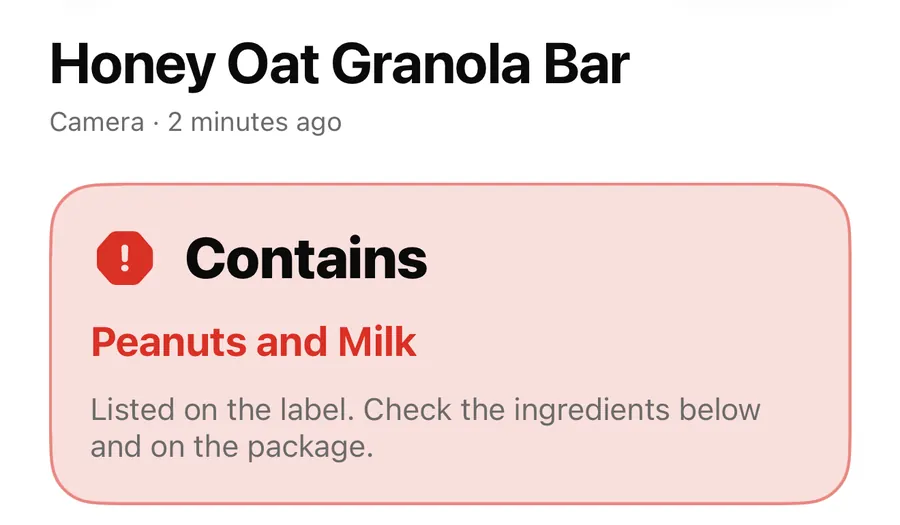
Contains, May contain, Couldn't read clearly: AllergenLens results explained
What each of the four AllergenLens result states means, how the card at the top is chosen, and what the app tells you when part of a label couldn't be read.
ReadE-numbers, other names and unclear words in AllergenLens
How AllergenLens reads E-numbers like E322 and E1105, explains what an additive can be made from, and marks misread or unknown words as Unclear to check.
Read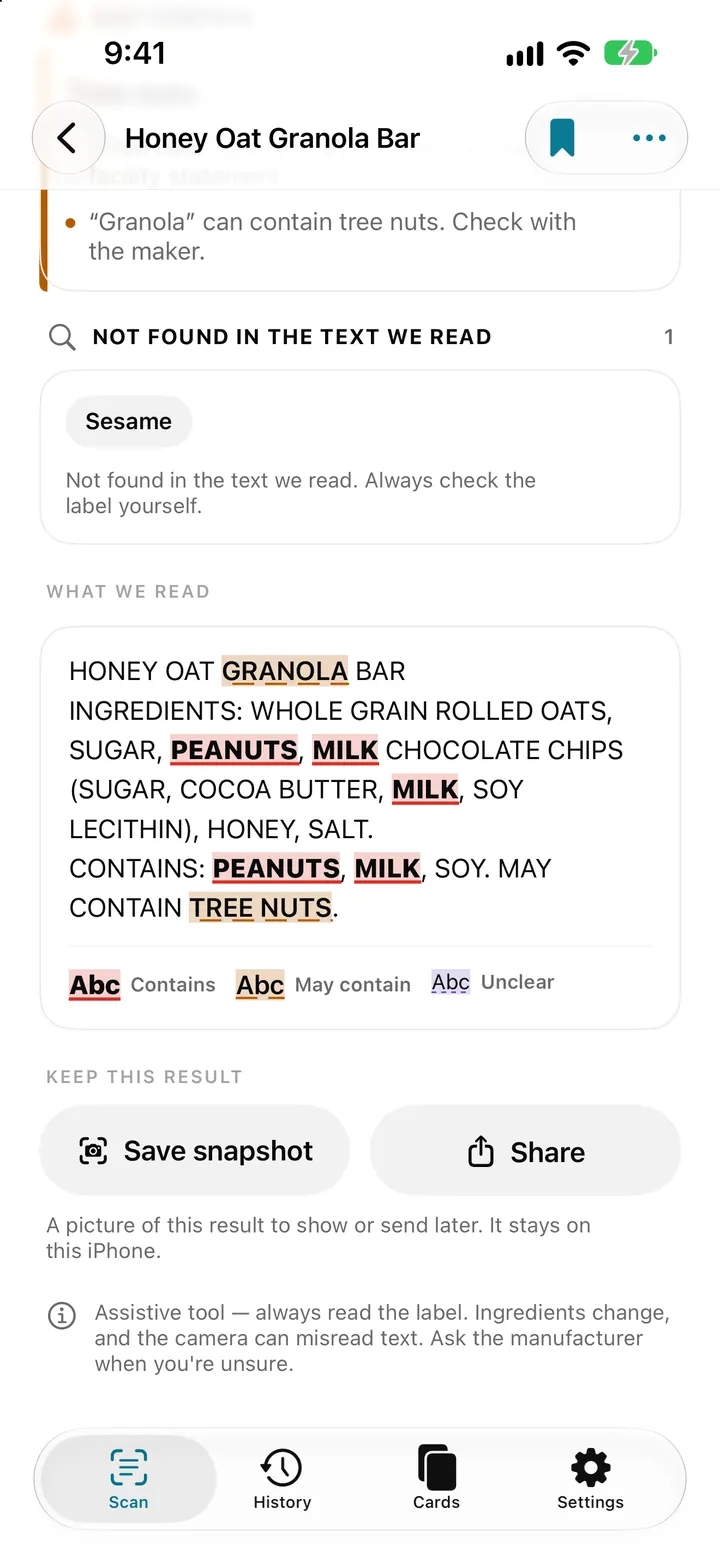
See every match on the label: highlights, Show on photo and Read aloud
AllergenLens marks each match in the text it read and on your label photo, so you can check it against the pack, then save a snapshot or hear it read aloud.
ReadWhat does ‘may contain’ mean on a food label?
Understand ‘may contain’, how it differs from ‘contains’ and how to use AllergenLens to review an allergen warning carefully.
Read guide